

English
Intent
At Holy Family Catholic School, English is woven seamlessly throughout our entire curriculum and school life. We have thoughtfully designed a curriculum that promotes enthusiasm and engagement in English and develops transferable skills applicable across all subjects.
Our commitment to providing pupils with rich and diverse opportunities is reflected in our selection of high-quality, challenging texts, which enhance their skills in speaking and listening, reading and writing – essential tools for their future success and personal growth, as articulated in our Mission Statement.
Oracy is central to our vision for English. We want every child to develop the confidence and communication skills to express their ideas, listen attentively and participate meaningfully in discussion. We recognise both the importance of learning to talk – developing effective speaking and listening skills – and learning through talk, using discussion to explore ideas, deepen understanding and support learning across the curriculum.
Within our diverse school community, we place particular importance on vocabulary development and access to language. We aim to enable all pupils, including those with English as an additional language (EAL) and special educational needs and disabilities (SEND), to participate, feel valued and have their voices heard.
We are dedicated to making meaningful connections to our school’s Catholic ethos. By incorporating elements of Catholic Social Teaching into our English lessons, we aim to nurture pupils’ academic skills and their moral and ethical understanding, preparing them to be compassionate and informed members of society. Through respectful discussion, pupils learn to consider different perspectives, recognise the dignity of others and use their voices thoughtfully and responsibly.
Aims
The overarching aim for English in the national curriculum is to promote high standards of language and literacy by equipping pupils with a strong command of the spoken and written word, and to develop their love of literature through widespread reading for enjoyment.
Our English curriculum aims to ensure that all pupils:
- Read confidently, fluently and with good understanding.
- Develop the habit of reading widely and often, for both pleasure and information.
- Acquire a wide vocabulary, an understanding of grammar and knowledge of linguistic conventions for reading, writing and spoken language.
- Appreciate our rich and varied literary heritage.
- Write clearly, accurately and coherently, adapting their language and style for a range of contexts, purposes and audiences.
- Use discussion in order to learn, elaborating and explaining their understanding and ideas clearly.
- Are competent in the arts of speaking and listening, making formal presentations, demonstrating to others and participating in debate.
- Listen actively, take turns and respond thoughtfully, building on the contributions of others and disagreeing respectfully.
- Develop the confidence to ask questions, explain their reasoning and adapt their spoken language for different purposes and audiences.
- Use talk to rehearse language, organise their thoughts and develop ideas before writing.
Implementation
At Holy Family, we want all our pupils to be confident and resilient speakers, readers and writers. Our English lessons develop spoken language, reading and phonics, writing, grammar, spelling and vocabulary.
Our writing curriculum is supported by Ready Steady Write, which uses high-quality texts to provide engaging contexts for writing. Pupils explore texts, develop vocabulary and understanding, and draw on modelled and shared writing as they move towards independent composition. Oral retelling, discussion and rehearsal help pupils develop and organise their ideas before writing.
We are developing a consistent whole-school approach to oracy, with clear expectations for speaking and listening. Planned opportunities for purposeful talk include partner and group discussion, storytelling, role play, poetry performance, presentations and debate. Teachers model effective communication and support pupils in explaining their ideas, asking relevant questions and responding to others.
As part of this approach, we are strengthening the use of discussion routines, sentence stems, explicit vocabulary teaching and visual support. These help pupils participate with increasing confidence and independence, particularly those with EAL or SEND. Opportunities for talk are adapted to pupils’ language and communication needs.
Phonics is taught using Letters and Sounds. Children are taught to segment and blend in their reading and writing through the phases. Teaching is informed by regular assessment, with teaching at pupils’ current phonics level and targeted intervention where needed. Decodable reading books are matched to pupils’ phonics knowledge so that they can practise and consolidate their learning.
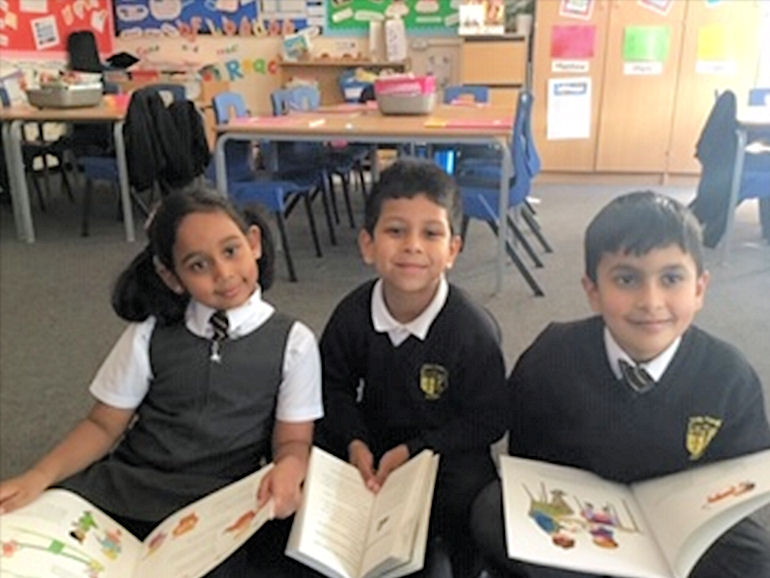
Pupils are expected to read every night and have their reading journals signed by an adult. Pupils take part in a range of reading activities in school, including whole-class reading, guided reading and individual reading, which encourage fluency and confidence using both fiction and non-fiction books.
In Key Stage 2, shared reading alternates with guided reading, with VIPERS questioning supporting the development of comprehension skills. Discussion of texts enables pupils to explore vocabulary, explain inferences, justify their opinions using evidence and consider different interpretations. Teacher modelling supports fluent, expressive reading and thoughtful responses to texts.
Our reading spine and focus authors introduce pupils to a range of texts and writers, supporting a culture of reading for pleasure. Pupils are encouraged to talk about books, share recommendations and develop their own reading preferences.
Spelling from Year 2 and in Key Stage 2 follows No Nonsense Spelling, and children are expected to learn spellings to support their written work.
Handwriting and presentation are expected to be of a high standard in English and across the curriculum. Nelson Handwriting is used from Years 1–6, while Reception follows the Sound Start letter-formation guidance and mantras.
We develop writing skills so that our children build the stamina and ability to write at the expected standard for their age. To support children in moving towards independent writing, we provide a wide range of activities, including film and imagery, music, ICT, trips and visits, modelled, shared and guided writing, peer assessment and discussion.
Throughout the writing process, pupils are supported to rehearse sentences aloud, explore vocabulary choices and discuss how to improve their work. This helps them make connections between spoken and written language and compose with greater clarity and purpose.
We provide varied and exciting opportunities for purposeful writing and encourage pupils to see themselves as authors and poets. We promote the importance of written work by providing opportunities for children’s writing to be read aloud and listened to by an audience. These opportunities also help pupils develop expression, consider their listeners and build confidence in presenting their work.
A range of additional activities promotes English within the school, including World Book Day, celebration assemblies, Star Writing, and after-school reading and phonics clubs.
Curriculum Overview
Impact
We evaluate the impact of our English curriculum through pupils’ work, assessment information, observations of learning and discussions with pupils. We look for sustained progress in speaking and listening, reading and writing, alongside pupils’ ability to apply their learning across the curriculum.
Supporting EAL pupils to gain confidence in speaking, listening, reading and writing is a significant priority in our school. We consider pupils’ starting points and individual needs when evaluating their progress, including their growing vocabulary, understanding and participation in learning.
As our whole-school oracy approach develops, we look for pupils to become increasingly confident in expressing ideas, listening attentively, asking questions and explaining their reasoning. Their contributions to discussion, presentations and responses to texts help us evaluate how effectively they use talk to communicate and learn.
As all aspects of English are integral to the curriculum, pupils have opportunities to transfer their writing skills into other subjects. This supports consolidation and a deeper understanding of how and when to use specific vocabulary, grammar and punctuation. Purposeful talk supports this transfer by helping pupils articulate their understanding and organise ideas before recording them in writing.
Our ambition is for pupils to leave Holy Family as confident communicators, enthusiastic readers and capable writers, equipped to participate fully in the next stage of their education and in wider society. We hope that their creativity, passion for English and high aspirations continue to grow and develop as they do.
What our Children Say…
“I love writing stories and letters because it’s fun and interesting to write in somebody else’s shoes. I enjoy reading different books and linking what happens in them to other stories. In Year 6 we have been reading and writing about the war.”
“I love using my sounds to help me write.”
“Reading is fun because we learn new vocabulary and some very tricky words like avaricious.”
“My teacher reads to us every day and we talk about our favourite characters.”